"Why
not think big? |
September 23rd and 24th
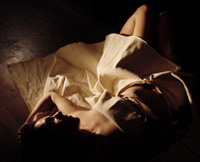
, 2002 Christina Braun PEACEDREAMS an evening of Butoh inspired works Come experience the waking dream of Christina Braun and her beloved co-conspirators against fear. Oakland based Dancer/Choreographer Christina Braun has curated a handful of friends to collaborate and not only perform, but offer a blueprint for change-PEACE. Shikeki Asakawa will create the poetry of sound in six movements that sway with the waves of the movement. His partner Minori Yata adds spoken word and furnishes the minimal set with offerings of fresh flowers and bamboo cane. Braun teams up with fellow Butoh artists: Molly Barrons, Desmonde Daisy, Delphine Mei and Martha Matsuda. Peacedreams is a series of experiences that Braun steers us through as she performs throughout the journey. Along the way she experiences: organic primal movement - linear duality- singing and sounding while Delphine Mei sings accapella and catching a beat and laughing. Peacedreams is a mutual dance theatre experience. Braun says "The ancient ritual of theatre, in the powerful symbolic language of dance are keys to deepening our respect for this life." Peacedreams is not only a result of the post 9-11 state of the world. These artists have assembled to, once again engage the power of creation to aid global healing. This dreamy evening will offer a breath of light into the possibilities beyond what Braun calls "the self -destructive culture". This performance marks an effort to further the power of the Bay Area peace hub of the Global Peace Network System. Braun stresses the importance of the interconnectedness of all creatures and cultures. |
|
|
|
 |
September 9th and 10th , 2002 Nemesio
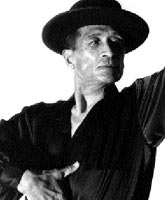
Paredes Flamenco Ensemble Homanaje a Jose Rizal After sold out performances last June, Nemesio Paredes Flamenco Ensemble returns with a special repeat performance of Homanaje a Jose Rizal at Theatre of YugenÕs Noh Space. An evening of dance, music, poetry (Spanish and Filipino), and a flamenco adaptation of "Mi Ultimo Adios", The epic poem by Jose Rizal, Filipino hero and martyr, written on the eve of his execution by the Spanish colonial regime. Nemesio Paredes, born in San Francisco of Filipino ancestry, first began dance training with San Francisco Ballet and later with Spanish classical and flamenco dance teachers in San Francisco and Spain. Among his renowned teachers have been Jose Galvan, La Tania, Ciro Maria Magdalena, Juan de los Reyes, Cruz Luna, Vadja and Guillermo del Oro. and Raul and Nora Dinzelbacher. He has appeared in San Francisco Opera's 'La Traviata' and 'Carmen,' and with flamenco dance companies in California: notably with Rosa Montoya's Bailes Flamenco, Theatre Flamenco of San Francisco, Patri Nader's Bailes Espana, and Juan Serrano and Amparo's 'Cuadro Espanol.' He was a featured soloist in SF's Ethnic Dance Festival, Men Dancing Series, Mirror of Life/Dance Action Series, Stanford University's Music Festival, SF's Stern Grove Summer Festival, and with the Tulare and San Jose Symphony Orchestras. He was on the teaching staff at San Jose Dance Theatre, and currently teaches at Classical Ballet of CA in Pacifica. He serves on the Isadora Duncan Dance Awards Committee. |
|
|
|
|
Are Native Americans rich? Will there be an Indian uprising? Does each Native person know everything about thanksgiving? How about everything on each of the over 500 tribal nations? Can you say "tribal"? Can you say "Indian"? |
August 12th and 13th , 2002 Revision
Production Company Lifestyles of the
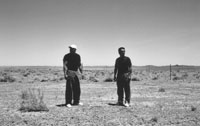
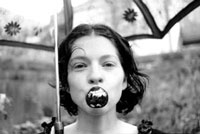
Rich and Infamous This production is an insight on how a few Native Americans live a day in their life. The thoughts, traditions, pains, and humor that are a part of the growth in a Native individual. This is an expression of the daily obstacles crossed as a person who is misrepresented by others, as well as their own, tries to sustain the dual lifestyles. Living, as many cultures do, in the respective ways of "your" people while maintaining your individual 'success' in society. Historical content is observed while the production caters primarily to character development. This production was inspired by the many conversations with people ranging from pre-school children to adults in higher education, foreigners to family members. It's a constant struggle to maintain an identity in respect to an ethnic culture while trying to sustain a modern lifestyle. It might just be easier to be a following member of the silhouetted masses. REVISION Production Company was established in 2000. Edwardo F. Madril - Eddie is of the Yaqui people from Arizona and Mexico. He has been participating as a plains style dancer and singer for 22 years, throughout the United States. Eddie has been in education for some time but spends much of his time educating himself in many interests. Marcos S. Madril - Having been a dancer for his whole life, Marcos believes there is much to be learned but even more to be taught in respect to Native America. His interest in 'the individual' has given him a profound insight on how we, as society see people and their purpose(s). |
|
|
|
 |
July 8th & 9th, 2002 Strangefruit Theatre Ensemble Collectibles and Curiosities two evenings of patchwork theatrics On a starry night a comet streaks across the sky. Characters facing their own mortality sing songs and tell stories about the end of spring, loving, leaving and the erratic stars that burn the prairies of the sky. Performers include Temple Crocker, Annie Kunjappy, Will Waghorn, Sean Hayes, Rowena Richie, John Polak, Roham Shaikani, and other special guests. Strangefruit is an experimental theater company founded in 1995 and is under the artistic direction of Temple Crocker and Annie Kunjappy. Strangefruit is dedicated to the creation of plays using texts from other genres such as poetry, short stories, memoirs and interviews. Ensemble members work collaboratively to create the total world of the play including staging, costumes, set and music. Strangefuit's production Sewing Lessons, a surrealist lifecycle based on the art and lives of Remedios Varo and Leonora Carrington, produced at the Noh space in the summer of 2001 achieved critical praise in both the S.F. Chronicle and S.F. Weekly. It was nominated for three CriticsÕ Choice Awards including direction, costume design and sound score. |
|
|
|
|
Monday and Tuesday, June 17th & 18th, 2002 OneThousandTearDrops
/ Poetry In Space Green Earth / Paradise Butoh, dance, Rap, Japanese Tea Ceremony, haunting and melodious soundscapes, audience participation, spoken word and poetry collide and unite at Noh Space when Poet / spoken word artist Minori Yata returns joined by co-collaborators Shigeki Asakawa (musician/soundscapes) and Butoh dancer Kinji Hayashi (one of the founding members of InkBoat). Monday's performance will include guest artists Kieko Yamamoto (dance) and a floral installation arranged by Tomoko Suenaga. Tuesday's special guests will be Richard Silver who will conduct a Japanese Tea Ceremony during the performance, and Rap performer Brent. Minori's Yata's performances create unique environments that inspire the viewers imagination and personal experiences to act as a guide for interpreting the performance. Utilizing the mediums of theatre, dance, spoken word, music and spatial installations Minori is able to create dynamic and eclectic environments that embrace and enchant the viewer. Minori Yata's series One Thousand Teardrops is dedicated to promoting world peace through art. |
|
|
|
|
|
"Half the people want to kill her and the other half want to sleep with her . . ."
"Because she is a woman, her crime is contagious." |
May 27th & 28th, 2002 Anthea Fane's Contagious After performing on stage and in film in New York for the last eight years, Anthea Fane returns to the Bay Area to work with director Jeffrey Bihr in "Contagious". Inspired by "Tragic Muse" a book by Rachel Brownstein, about the life of Rachel Felix (1821-58). "Obsession, murder and the search for a new identity." Rachel, who was born to a family of poor Jewish peddlers, re-invented herself as a great tragedienne and became an International superstar. Rachel herself however never shows up in the piece, left to the imagination. The play explores the lives of four women who use the stories about "The Tragic Queen," to find their own identity. Through their monologues, the story unfolds of how one woman falls in love with Rachel, and trades her real life for a Tragedy. Although every character in the play is in some way trying to become more like Rachel, they are really trying to become a fantasy version of themselves. The play asks the questions; Can you invent yourself? And how valid is the imaginary world? If you completely believe in something can it become real? Finally, as a Yiddish proverb asks, "If I try to be her, who will be me?" |
|
|
|
|
|
Four Seasons of Japan:
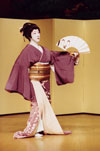
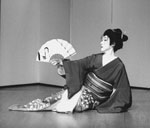
Monday April 22 & Tuesday April 23 2002 8:00pm Jiuta-mai dancers Shochika Azusa from Marin, Itsuha Kano from Tokyo, Japan and Yuki Fujima from San Francisco perform with San Francisco musicians Philip Flavin(Shamisen), Shoko Hikage(Koto), and Robin Hartshorne(Shakuhachi). Jiuta is a song accompanied by the Shamisen*, which was developed in Tokyo and Osaka originating in the beginning of the Edo era (early 17th century). Later in Kamigata (Osaka region) it developed its own distinctive style of Jiuta, using the Shamisen together with Koto**. Jiuta music was mainly composed and played by several classifications of blind monks; Kengyo, Kohtoh, and Zatoh. During the years of Kansei and Genroku (1688-1800), Jiuta was primarily a song accompanied by both instruments, but during years of Bunka and Bunsei (1804-1829) it developed an instrumental part, Tegoto (hand-affair) which includes a solo Shamisen part in the Jiuta song. Its Shamisen player plucks gently on the wooden part of the upper body with a thick large plectrum. The skillful performance creates more delicate variations than any other Shamisen music. The intricate use of left handed fingering is especially important. Jiuta Mai is a Kamigata style dance accompanied by Jiuta music. Originally it was danced on the space of only one or two tatami mats in the Japanese room under dim light, not like the current theater space. Movement and expression are controlled by the dancerÕs introverted energy and each foot and hand movement must match with each note of Shamisen music, expresses the subtlety of her/his inner mind. Jiuta-Mai is exceptional in its expression of graceful as well as slightly sensual beauty. Jiuta-Mai deeply demonstrates its characteristic mood in the dance describing the feelings of love. |
|
|
|
 |
URBAN BUTOH strain Monday April 8 & Tuesday April 9 2002 8pm San Francisco is a petri dish for evolving Butoh strains. Berkeley based Butoh masters Koichi and Hiroko Tamano have been the resident catalysts for Butoh in the Bay Area for over 23 years. The Tamano's have paved the road for American and in particular Bay Area Butoh artists. One example is San Francisco dancer Molly Barrons who has studied and performed with the TamanoÕs in their company Harupin-Ha since 1993. Barrons is the driving inspiration behind Urban Butoh Strain. Barrons was joined by dancers Antonio Delbenes and Mark Hellar for a Harupin - Ha performance in the San Francisco Butoh Festival 2000 at Theater Artaud. The three company members have studied and performed together since 2000 in the Bay Area and in New Mexico. In 2001 the Tamano's and Harupin-Ha were artists in residency for one week at Wayne State University in Detroit where they created "Motor City ButohÕ. Urban Butoh Strain features 5 San Francisco Butoh Artists: Molly Barrons, Antonio Delbenes, Tappie Dufresne, Mark Hellar and Martha Matsuda (Oakland). Urban Butoh Strain will include 4 (15 minute) solo's including: "68" is performed by Molly Barrons with an original score by Detroit based electronic musician Munk. 68 examines the urban body, street gestures and the stamina necessary to endure the race riots in Detroit in 1968. Martha Matsuda performs "Stand". "Stand" focuses on the metaphor of standing as a way of being in the world: standing tall, taking up space and having the right to exist just because one exists. Mark Hellar will perform a solo that includes traces of his Martial Arts training in Tae Kwan Do. Antonio Delbenes performs a solo that employs the energy from the present moment and seeks to create unity through movement. The collective work reunites Molly Barrons with dancer Tappie Dufresne. Barrons choreographed a duet entitled "Outside" which they performed at the 1999 San Francisco Butoh Festival Marathon at ODC Theater. The collective work entitled Urban Butoh Strain (15min.) was inspired by Barrons, Delbenes and Hellar and reverberates with imprints of their Hijikata style of training with the Tamano's. Urban Butoh Strain examines how transforming cellular activity through imagery produces energy, movement and form. Although there are many layers of images the urban body and experience is a texture undeniable to the group as this is our landscape. |
|
|
|
 |
March 18 & 19th Kenshi Nohmi's Ryutai
(Fluid) Co-presented by An Creative. "Supported bt The Tokyo International Foundation" Kenshi Nohmi is a graduate of the dance department of Nippon Health & Sporting Academy. He has studied Modern Dance under Mr. Tatsuo Mochizuki and Classic Ballet under Mr. Isamu Hashiura. He has also studied American Contemporary Dance in Tokyo and in New York under Ms. Kazuko Hirabayashi, a professor at the Julliard School. Kenshi Nohmi is an instructor and choreographer for the Dance department of Tokyo Communication Art School. In 1997 he organized "Dance Theatre 21", and has been engaged in its activities as an Artistic director. Kenshi Nohmi's work Ryutai (Fluid) is aimed at expressing the resonance between water and human beings. It incorporates KenshiÕs impression of Karesansui, a style of Japanese garden that he experienced on a journey to Kyoto, as well as his own memories and notions of water. Karesansui is a dry landscape garden composed of rocks and sand in addition to trees. The rocks and sand represent mountains and water, respectively. The use of the space is intended to represent images fluidity, circularity, memory, vision, ideals and direction. A world is created that is inorganic and serene, with both movement and stillness. Three dancers repeat curved and linear movements that recall the tranquility of floating on the water. Then there is a sudden change Ð the movements accelerate and expand, the way water heats up within the body. TANNO KENI'CHI will perform PUNK EXECUTION- SHORT SOLO WORKS 014-SCAR 011-DOT 012-RAG Tanno has been creating original works since 1985, after participatingin the fourth "Maijuku". At that time, his works caused a fuss, because of his intense level of expression. TannoÕs performances have occurred outdoors, in the ruins of a hospital, in a train, andintruding into a hamburger shop. After 1992, he began creating solo works with large scale stage setting, original body movements, and an action which twine with "Object". Lately, since 2000 his work became simpler while still dynamic, acting as multiple characters, utilizing make-up and costume. His solo works have won a reputation as breaking new ground both in Japan and recognized in the NY Times in 2001 |
|
|
|
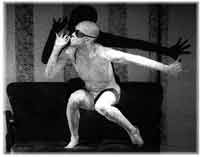 |
March 4th & 5th Shinichi Momo Koga, Ledoh, and Kinji Hayashi Improvisation Shinichi Momo Koga is a body theatre alchemist whose productions, both solo and ensembl,e have been experienced internationally since 1988. Momo breaks down dance, theater, and film forms, restructuring and extracting the essence of each. Heavily influenced by his training in Butoh Dance, Tadashi Suzuki Theater Method, filmmaking and photography, Momo has founded numerous groups including inkBoat (San Francisco) and adapt (Berlin/ with Yuko Kaseki, Minako Seki and Sten Rudstrom). In the past, he has worked extensively with Yumiko Yoshioka and TEN PEN Chii (Deutchland), Larry Reed's Shadowlight Theater (USA), Koichi Tamano's Harupin-Ha Butoh Dance Theatre (USA), and Do Teatr (Russia). As a teacher, performer, and director, Momo inhabits the shadow self and the collision between modern life and primal being. He challenges himself and others to attain balances of chaos and serenity, to be a raging storm in blue skies and a breath of calm in the midst of turbulence. |
|
|
|
 |
February 18 & 19th The
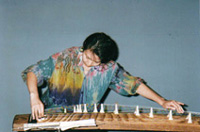
Koto Trio Shoko Hikagi and friends perform muscial arrangements for mulitple Kotos. There is something that cannot be experienced through solo koto performance, or with ensembles involving other types of instruments. It is a certain unique interplay - the resounding of the strings of the 13 and 17 string koto in ensemble. Through modern works and improvisations, including original pieces and commissioned works by composers from around the world, these dedicated Koto musicians will continually explore and expand on new musical possibilities for koto ensemble. All of the trio's members are associated with the Sawai Koto Institute (Tokyo). Founded in 1979 by Tadao and Kazue Sawai, this organization is recognized for its unique artistry and emphasis placed on contemporary music for the koto. Ryuko Mizutani, Shoko Hikage, and Curtis Patterson each have unique experiences in the US and Japan performing solo, with ensembles and in collaborations with various musicians and artists. All of the members have spent years studying and performing in Japan, and they hold teaching degrees from the Sawai Koto institute. Three like-minded performers, with similar backgrounds, looking to expand performance experiences and feel that too little is known of the koto, and especially the modern repertoire for the instrument and its improvisational possibilities. What they all do share, is their commitment to and love for the koto, its unique sound and the repertoire that has developed around the instrument. It is with the hope of introducing the fascinating world of contemporary and improvisational music for koto ensemble to wider audiences, that the trio was founded this year. |
|
|
|
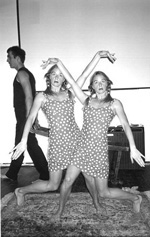 |
February 11 & 12th My Funny Valentine A collaboration by Nadja Haas (San Francisco) and Torsten Haase (Berlin) Renaissance Woman meets modern Dandy, an abstract collage of vignettes. The dance-theater piece MY FUNNY VALENTINE is an honest story about two people in search of a home, a home for the soul. A pregnant woman and a gay man are trying to find out who they are. Both people are fighting through the labyrinth of emotions and reactions of their environment the modern metropolis. In the stage created by the back and forth between attraction and repelling of each other, the couple marks their search for happiness and idyll home. Both have different life concepts and dreams. The woman, a Renaissance woman is looking for positivism and spiritualismin sunny California and the man a modern Dandy is striving for decadence and melancholy in Berlin. Although they live in different locations they are deeply connected and their life paths intertwined. They meet and create synergies that produce a short-lived location. This location is not tangible for the eye but is very tangible for the heart. |
|
|
|
|
|
January 21 & 22, 2001 Artemis
Anderson & Omen Project &
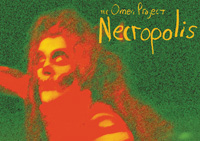
Nemo Re-Bound: Movement in Tethers - Artemis Anderson presents her movement performance work Re-Bound, a visually striking exploration into the imprisonment of the human psyche. In this work, sensual images layer with visceral movement to illustrate the isolation and grief of human disconnection. Profoundly influenced by Butoh, Artemis works with both disconcerting and voluptuous movement as well as Shibari, Japanese bondage, to evoke a world where spoken communication is no longer effective currency. Drawing upon mythological paradoxes such as the archetypal blind oracle, Re-Bound creates a timelessness where universal themes of human destitution come to light. Re-Bound, at once sensual and dark, illuminates the devastation resulting from the sociological and self-imposed boundaries and limitations exacted upon the psyche. NecropolisÉ an incantation for the dead - by Nemo The Omen Project presents Necropolis, a multimedia theater work which weaves together hallucinatory visuals, Butoh-influenced movement and scathing text to transport the audience into the hyper-real world of a waking nightmare. Propelled into the city of the dead, Nemo is stripped of his acculturated identity, revealing the stark, visceral and primal nature of being. Deeply inspired by Antonin Artaud and the works of the surrealists, Necropolis explores the inextricable connection between the body and death with the intent to shake our complacent and illusory view of reality, asking performer and audience alike to question and seek further. NecropolisÕ florid and nightmarish images, cutting dialogue and fervent movement launch the observer beyond the boundaries of time and space into the haunted recesses of the human psyche, ultimately discovering a deeper connection to waking life. |
|
|
|
|
|
December 14 & 15, 2001 TUJU TAKSU MASKED
DANCE THEATRE Passengers of Light Performed by Dhyanis,
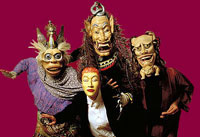
John Michael Doyle, Maru Matthaei, Directed by Maru Matthaei Tuju Taksu, an innovative performance troupe that features original masks created, blessed and danced in Bali, premieres a new work, Passengers of Light, seamlessly blending masks, movement, and music, the dance theatre presentation explores universal archetypes and myths. The work of this contemporary dance troupe is the result of a ten year collaboration between Balinese master mask maker Ida Bagus Oka and American choreographer Maru Matthaei. Meaning aiming (tuju) for a certain spiritual inspiration (taksu) Tuju Taksu performances are characterized by their highly original masks and the different dancer's interpretations of the characters. In the past six years they have been performing both in Bali and the Bay Area, with dancers from different nationalities and cultures adding depth to the universal themes and story lines dealt with in the performed dramas. Since all the pieces contain improvisation, each performer brings an individual interpretation to the piece, so each performance is unique. New masks have led to different dances and characters, adding new life to each show. Prepare for an evening of highly original entertainmet. |
|
|
|
 |
December 3rd and 4th Paducah
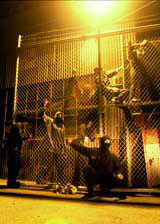
Mining Co. 611 $upreme by E. Hunter Spreen An "environmental
thriller" where capitalism, global warming, |
|
|
|
|
August 6th and 7th One Thousand Teardrops Poetry in Space - An installation with live music and dance Produced and Directed
by Minori Yata A "four dimensional poetry of imporvisation" utilizing art installation, music, sound and live perfomers together with Minori's simple poetry and spoken word to create Poetry in Space. Peace - A Piece of Dream is a memorial to victims of Hiroshima and Nagasaki as well as all those effected by the tragedy of war. |
|
|
|
|
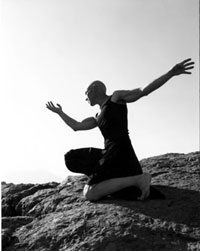 |
July 16th and 17th Medicine Wheel Dance Project The woman who fell from the sky. |